Riparian belts are areas and surfaces located in the immediate vicinity of water bodies (streams, rivers, or lakes), where periodic or occasional flooding occurs. These forest communities, together with the watercourse alongside which they develop, constitute an essential component of the structure and functioning of coastal and riverine landscapes. Riparian zones encompass not only the active channel of the water body (stream, river, or lake), but also the adjacent exposed areas, as well as floodplains situated above and in close proximity to the shoreline. They are characterized by the presence of specific flora and fauna, whose structure depends on natural hydrological regimes that reflect the characteristics of the given landscape.
These forest ecosystems are important because they provide high biomass productivity, support numerous species (high biodiversity), and deliver a range of ecological services, including flood and soil erosion control, removal of nutrients from agricultural runoff, mitigation of pollution effects, and functioning as habitats and refuges for birds and mammals.
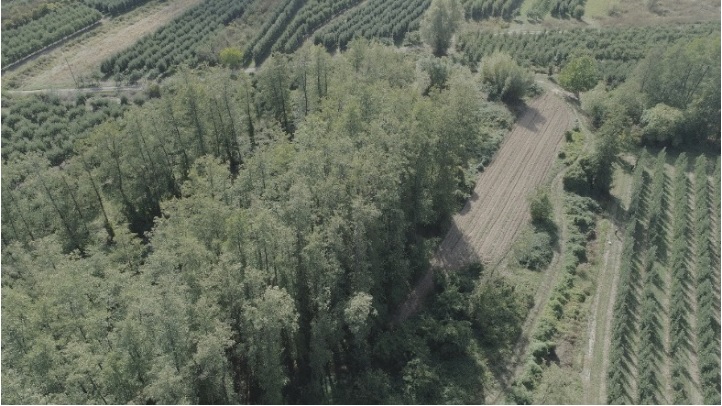
Impact of riparian forests on human activities
(encroachment of agricultural areas onto natural habitats of alder forests)
In the absence of human activities and disturbances - primarily those related to land-use change—riparian vegetation communities support numerous functions, including bank stabilization through root systems that reinforce the soil, deposition of sediment in flooded areas during periods of excessive flow, water filtration through sediment layers, and the provision of large amounts of woody material, which significantly influences channel complexity and in-stream habitat characteristics.
Alluvial alder forests
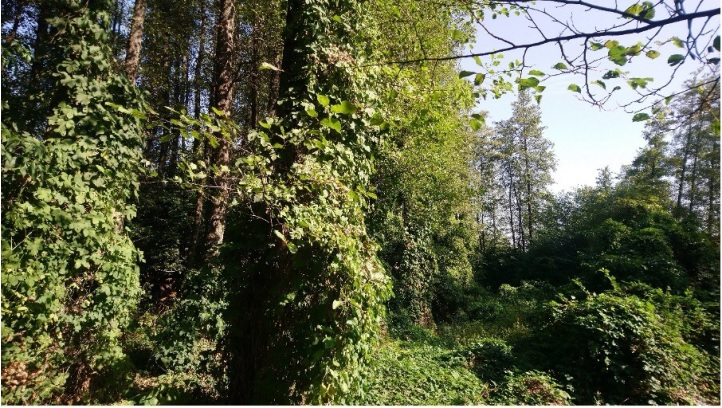
Forests in the Prespa Lake region are relatively well represented in terms of coverage: habitat type 91E0* (alluvial alder forests) covers approximately 130 hectares (0.65% of the total surveyed area), while willow stands or gallery forests of habitat type 92A0 (Salix alba) cover 491 hectares (2.47% of the total surveyed area). However, they are not distributed as a continuous forest belt, but rather occur as a large number of separate forest patches, indicating their relatively recent origin (mainly following the retreat of the lakeshore at the end of the last century). Unfortunately, forests with mature and old trees (near the village of Ezerani) have been almost entirely destroyed. The connection of these forest stands through continuous natural succession would result in the establishment of larger forest complexes with greater ecological value, particularly as wildlife habitats.
Older alder trees in Prespa develop and grow on alluvial and sandy soils along the lakeshore and are mainly represented by remnants of former old alder forests. Approximately 42% of the total alder forest area (130 ha) is located within the boundaries of the Ezerani Nature Park, amounting to 54.52 hectares, distributed across 88 smaller or larger forest stands.